Businesses in ChatGPT:
OpenAI built your brand a storefront in ChatGPT. Post-purchase support still lands in your helpdesk.
OpenAI's new 'Businesses in ChatGPT' lets brands claim a profile and publish a Business Agent, and ChatGPT's Dots agents now have a wallet. The buying moved into ChatGPT. The orders, returns and post-purchase support didn't. Here's what that means for eCommerce support teams.
OpenAI's new 'Businesses in ChatGPT' lets brands claim a profile and publish a Business Agent, and ChatGPT's Dots agents now have a wallet. The buying moved into ChatGPT. The orders, returns and post-purchase support didn't. Here's what that means for eCommerce support teams.
Last week, OpenAI opened the front half of your AI-native storefront inside ChatGPT, and it's waiting for you to stock the shelves...
On November 10, it opened Businesses in ChatGPT in beta: brands can claim a profile, add product feeds and publish a Business Agent that answers shoppers' questions. On November 13, it launched ChatGPT Wallet, so its Dots agents can pay for what they find. Alongside both sits a Commerce Partner Playbook telling merchants what to build.
Read the playbook closely and one line stands out. From the payments guide: "Your business handles the order, fulfillment, customer support, and fraud decisions."
The buying moved into ChatGPT. The support didn't. And if "claim your business profile now" sounds familiar, it should. Brands have been sprinting to grab their name since Facebook's username land rush in 2009: the coveted four-letter Twitter handle, the Foursquare venue, the Vine account, the Periscope, the Ello invite, the .eth name, the Mastodon instance, the BeReal, and, lately, the llms.txt file. (Guilty.) Somewhere, a marketing coordinator still has all those passwords in a spreadsheet.
What OpenAI just launched
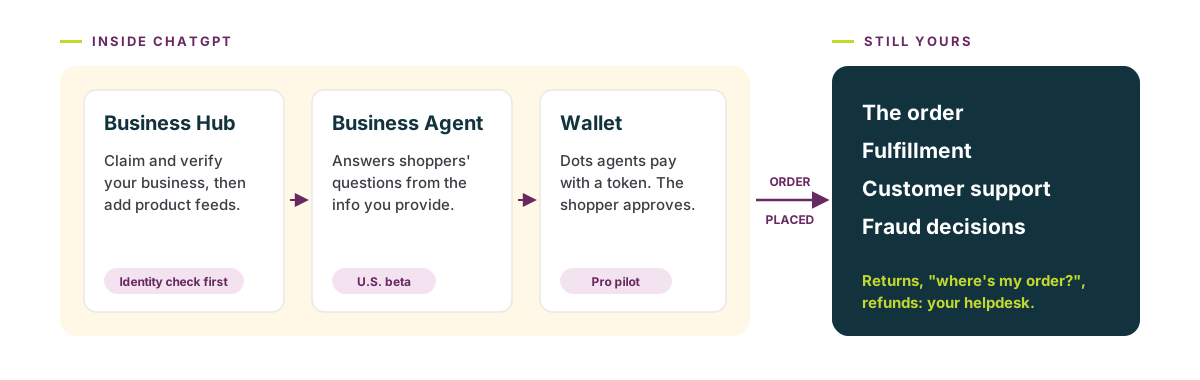
Business Hub. A brand claims and verifies its business, then manages what ChatGPT shows about it. Once verified, OpenAI says, companies can "update key details and add self-service product feeds with pricing and availability." Business Hub also shows aggregated insights: mentions, website clicks and "discovery topics," the common themes across conversations where your site is cited. Shopify merchants can connect their store from Business Hub or the Shopify admin "to streamline verification," and eligible Shopify products "are already integrated into ChatGPT through Shopify Catalog."
Business Agents. After claiming a profile, eligible businesses "can build, test, and launch a Business Agent." A shopper who finds you in a ChatGPT answer can open a conversation with it and ask follow-up questions, which it answers "using the business's information." OpenAI says that conversation is "clearly labeled, separate from the customer's original ChatGPT conversation, and distinct from ChatGPT's independent answers." For now, agents are limited to "eligible ecommerce and online service businesses in the U.S." Businesses can also "sponsor their Business Agent and use it as the destination for ChatGPT Ads."
ChatGPT Wallet. The shopper adds a card once, then approves each purchase a Dots agent makes with a security check "such as Face ID or a fingerprint scan." The payment network issues a token, so neither the agent nor the business sees the actual card details. It starts with "ChatGPT Pro subscribers aged 18 and older in the US with eligible US-issued cards." For merchants, OpenAI says it "works out of the box with existing checkout pages and payment forms."
Claim your handle now!
Every few years, a platform tells brands to grab their spot before someone else does:
- 2011: Google+ brand pages. Google shut Google+ down for consumers in 2019.
- 2014: Twitter's Buy button. It quietly went away.
- 2016: Messenger bots, back when "bots are the new apps" was a keynote slide.
- 2021: Clubhouse. You reserved the handle. Did you ever host a room?
- 2023: ChatGPT plugins, OpenAI's first "bring your business into ChatGPT" push. They were retired about a year later.
- 2023: Threads, Bluesky, and whichever app was replacing Twitter that month.
- 2024: the GPT Store. How's your brand's custom GPT doing?
- 2024: Google shut down Business Messages, the chat button it had asked brands to add to Search and Maps.
Some of those became real channels. Most became a login nobody remembers.
One thing really is different this time: you have to prove you're you. Claiming a profile starts with an application, and before you can upload a single product, OpenAI's product feed guide has you verify your identity in Business Hub. Every earlier rush was first come, first served. Squatters grabbed brand names on Twitter, on Instagram and on .eth, and you paid them or filed a complaint to get yours back. Now the platform checks who you are before it lets you sell. When an agent is about to spend a shopper's money, that's the only sane design, and it's a real break from the grab-your-name-before-someone-else-does decade.
To be fair, ChatGPT already has the audience most of those never did: OpenAI says 1.2 billion people use it every week. But it's the same pitch, and this is OpenAI's third time making it: show up, fill in the profile, feed it your catalog, and trust that the traffic follows. This version comes with two twists. You don't get the conversations back, and you can already pay to sponsor your agent. The free profile ships with an ad product attached.
About that pre-holiday timing...
OpenAI opened Business Hub on November 10, seventeen days before Black Friday. That's code-freeze season (at least for those of us with enough grey hairs to remember when that was a thing). Your catalog team isn't wiring up a new product feed this month, and your support team is busy staffing up for the busiest six weeks of the year.
And look at who can actually use it. Business Agents are a U.S.-only beta. Wallet starts with what OpenAI calls "limited availability to ChatGPT Pro users." So this holiday, the real effect isn't sales through ChatGPT. It's shoppers asking ChatGPT about your shipping cutoffs and return window, and getting an answer either from your Business Agent, if you set one up, or from whatever ChatGPT found about you on the web, if you didn't.
Either way, the ticket lands with you. And when agents do buy, expect a new kind of ticket: OpenAI warns that risk systems "may still flag legitimate purchases made by agents, leading to declines or cancellations."
What a Business Agent can't do
This is the part support leaders should read twice.
A Business Agent answers questions about what you sell. It doesn't handle what happens after the sale. At launch, eWeek reported that Business Agents "cannot complete purchases, arrange bookings, or check existing orders."
And whatever shoppers ask it, you won't see it. OpenAI is plain about that: "We don't share users' conversations or Business Agent chats with businesses." You get the aggregated topics, not the transcript.
So picture the flow. A shopper asks your Business Agent whether a jacket runs small and what the return window is. It answers from your feed and your policies. They buy, maybe through a Dots agent with Wallet. Two weeks later the jacket is too small. Where does that conversation go?
To you. OpenAI's agent access FAQ says so directly: "any customer service or support should be handled in the same way you would if a customer took the action themselves." The Wallet announcement is even plainer: businesses "keep their customer relationships and control over pricing, fulfillment, returns, and customer service." OpenAI frames that as a feature. For your support team, it's the job description.
The playbook stops at checkout
OpenAI's plugin guide shows the retail tools it expects merchants to expose: product lookup, carts, checkout, and order history for reordering. There's nothing for order status, returns, cancellations or address changes.
The closest it gets is identity. OpenAI recommends Sign in with ChatGPT "especially when customers need to stay signed in across visits or identify themselves for checkout, order tracking, refunds, or discounts." The customer can prove who they are. The order tracking and the refund are still your systems' job, and your support team's.
Our take: This is the right split, and it isn't a gap OpenAI forgot. A brand's Business Agent shouldn't be issuing refunds from someone else's app. But be clear about the trade. OpenAI keeps the conversation, the shopper and the ad inventory. You keep the returns. The agent making promises before the sale and the team keeping them after it now sit in different places, with no shared transcript between them.
What to do before the January returns wave
- Claim your profile anyway, and name an owner. Not because it'll move holiday revenue. Because ChatGPT is already answering questions about you, and a Business Agent at least answers "using information you provide." If nobody owns that information, the agent will quote last season's return window with total confidence.
- Make your policies match what support will honor. Returns, exchanges, shipping times, price adjustments. Whatever the agent says, your team inherits.
- Check you aren't blocking Dots by accident. OpenAI's access guide says security settings "may unintentionally block" ChatGPT's cloud browser, and shows how to allow verified traffic. Whether you want to let agents in is a bigger question, and Rob takes it on next month.
- Track where the conversation started. You won't get the Business Agent transcript, so ask. A ticket field or tag for "found us in ChatGPT" tells you whether those promises are causing the tickets.
- Get your post-purchase actions agent-ready. The customer's assistant will eventually come asking about the order, too. Make your real support findable through Zendesk's Open Service Directory, and decide which outside agents may act in your help desk with Zendesk Bridge.
That last step is the work we do at agnoStack: getting from the ticket to the order, on whichever commerce platform it lives, so the questions ChatGPT sends your way can be answered in one place.
OpenAI built your brand a storefront in ChatGPT. The returns counter is still yours to run. Claim the handle if you like. Just staff the counter first.
Sources
- https://openai.com/index/introducing-businesses-chatgpt/
- https://community.openai.com/t/introducing-businesses-in-chatgpt-in-beta/1414865
- https://x.com/OpenAI/status/2120216592395174382
- https://help.openai.com/en/articles/20001635-setting-up-your-business-on-chatgpt
- https://openai.com/policies/business-agents-policy/
- https://openai.com/index/introducing-chatgpt-wallet/
- https://developers.openai.com/commerce/guides/overview
- https://developers.openai.com/commerce/guides/accept-payments
- https://developers.openai.com/commerce/guides/build-a-plugin
- https://developers.openai.com/commerce/guides/integrate-sign-in-with-chatgpt
- https://developers.openai.com/commerce/agent-access
- https://www.eweek.com/news/openai-chatgpt-business-agents/
Keep reading
All posts →Blog
Zendesk AI Summit 2026: Outcome AI Platform, Zendesk Bridge, and the Open Service Directory
Zendesk Bridge brings Zendesk to AI agents like ChatGPT and Claude, alongside Specialized AI Agents for retail, outcome-based pricing with Zendesk Unlimited, and what the Open Service Directory means for the future of CX.

Blog
The first agentic holiday season: A post-purchase checklist for Black Friday and Cyber Monday 2026
This is the first Black Friday where AI agents can check out on a shopper's behalf. Here's why post-purchase is what will decide who wins it, and a checklist to get ready before November 27.
Engineering
Zendesk's Open Service Directory: How Personal AI Assistants find Customer Support
Zendesk's Open Service Directory gives personal AI assistants a verified way to find a brand's official support. Here's how it works, what it isn't, the open questions, and what commerce brands need behind it.