
Zendesk AI Summit 2026:
Outcome AI Platform, Zendesk Bridge, and the Open Service Directory
Zendesk Bridge brings Zendesk to AI agents like ChatGPT and Claude, alongside Specialized AI Agents for retail, outcome-based pricing with Zendesk Unlimited, and what the Open Service Directory means for the future of CX.
Zendesk Bridge brings Zendesk to AI agents like ChatGPT and Claude, alongside Specialized AI Agents for retail, outcome-based pricing with Zendesk Unlimited, and what the Open Service Directory means for the future of CX.
On AI Summit day I shared some first reactions on LinkedIn: Zendesk throwing the doors open to everyone else's AI agents, commerce going first with Specialized AI Agents, and pricing on outcomes instead of seats. I promised a wider walk-through, so here it is.
Last week we wrote about Zendesk's Open Service Directory, a draft spec and public directory that helps a customer's own AI assistant find a brand's real support. Zendesk's AI Summit on November 12 put that idea inside a much bigger package.
Zendesk announced Zendesk Unlimited and the Outcome AI Platform two days before the summit, and the keynote, "Meet the autonomous workforce," built on both.
Here's what was announced, what's still early, and what it means when the one asking "where's my order?" isn't even a person anymore.
What Zendesk announced
Start with the name. What Zendesk called the Resolution Platform at Relate 2025 is now the Outcome AI Platform, and the new name tells you where the pricing is going. Zendesk groups it into access, deeper work and continuous improvement. The pieces, with the status Zendesk gives each one in its announcement:
- Zendesk Bridge connects outside AI agents to Zendesk. Early access.
- Specialized AI Agents, both Industry Agents and Custom Agents. Generally available.
- Self-Improving Zendesk is the improvement loop: Agentic Analytics, Admin Copilot, an AI Agent Launchpad for testing changes before they go live, and a Quality Score, with people approving what changes. Generally available.
- Open Service Directory is "launching soon."
Since Relate in May, which brought Action Flows, an MCP client and server, connectors and pricing on resolutions, the summit adds two big things: an access layer for agents Zendesk didn't build, and a new commercial model.
Zendesk Bridge: your AI agents, Zendesk's rules
The biggest move of the summit wasn't another Zendesk agent. It was Zendesk throwing the doors open to everyone else's. Zendesk Bridge lets AI agents like ChatGPT, Claude, Microsoft Copilot, Gemini or one you built work with Zendesk while not in Zendesk. Yes, you read that right. They get more than 400 tools over MCP, and, over time, can hand work to Zendesk's own AI agents over A2A.
Our take: The part we like isn't flashy, but it's exactly what decides whether anyone lets an AI agent anywhere near a refund: Zendesk sets the house rules, and the agents have to follow them.
Those rules are what make it more than an MCP server. Per the Bridge FAQ:
- No access by default. "External AI agents start with no access." Admins choose which agent connects, which groups use it and which tools it gets.
- No privilege elevation. "Making a tool available does not elevate the acting user's Zendesk privileges."
- A separate record. Audit records distinguish the agent from the person it acted for.
It's early access and free for now, with destructive actions, bulk exports and third-party integrations not supported yet, and metering phasing in through general availability in 2027.
There's a lot more to say about Bridge than fits in a recap: how a connection works, what's actually in early access, and how an outside agent gets from a ticket to the order. Rob digs into all of it in our engineering post tomorrow.
Pricing: unlimited seats and an outcome budget
Zendesk Unlimited removes seat limits. Customers set an Outcome Budget and pay for eligible issues resolved and business work completed, and Zendesk says it checks each outcome for quality and completeness. Its blog defines two kinds of outcome: conversational, where an issue is addressed within an interaction, and operational, where an automated workflow completes across business systems. No per-outcome rates were published.
The open question is who decides what counts as resolved. Zendesk told diginomica it will adopt each customer's own success metrics, which is reasonable, and also where the disputes will happen. Internal Note's take on Agentic Analytics makes the same point from the measurement side: as Zendesk takes on more kinds of work, "counting just solved conversations tells us nothing about the outcome of what the platform actually delivered." Outcome pricing only works if both sides trust that measurement.
The piece we expect the most debate on is Advanced Action Flows, the multi-system workflows Zendesk made generally available last week. They're how AI agents actually finish the job in other systems, and their pricing has already been through a few versions. In August, Zendesk stopped charging action credits for native actions. On November 10, it dropped action credits for Action Flows altogether. Advanced Action Flows arrived alongside custom agents and agentic analytics as outcome-based features, free until February 1. And the latest version, in Zendesk's own comparison and in the admin center itself, is narrower again: advanced flows use "neither action credits nor model tokens unless you add an AI step," and from February 1 a flow with AI steps costs $0.15 a run, unless an AI agent runs it. Add automated resolutions for employee service AI agents (10 or 15 per agent a month, then $0.99 each, per Zendesk's announcement) and "operational outcomes" in the Outcome Budget, and Zendesk still hasn't said which of those a flow counts against when an AI agent runs it. For brands whose agents act on orders, that answer is the price.
Specialized AI Agents and Custom Agents
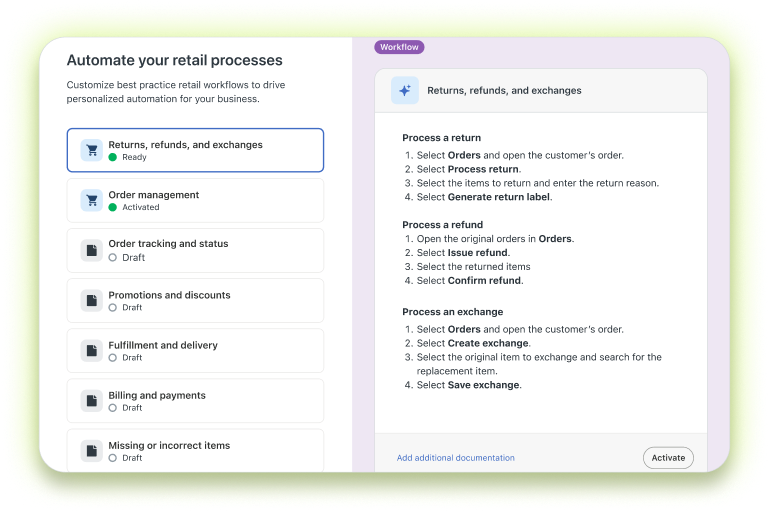
Industry Agents come preconfigured for a vertical, and Custom Agents are built for your own workflows. Zendesk's Specialized AI Agents announcement starts with commerce, connecting to systems such as Shopify, Narvar, Stripe and Riskified to "take action without requiring customers or service teams to move between multiple systems."
Zendesk agents on its rivals' platforms
The detail that stood out to us: Industry and Custom Agents "can run in Zendesk or in service environments including Salesforce and ServiceNow." You heard that right: Zendesk's agents, running in its RIVALS' PLATFORMS. For more on the Custom Agent side, see our post on Zendesk Custom Agents.
Our take: A CX platform happily shipping agents into its rivals' platforms tells you where it thinks the value is now: in the work getting done, not in the seat.
What this means for commerce support
Order status, returns, refunds and account changes are exactly the jobs the Bridge FAQ lists, and commerce is where the first Industry Agents point. For a brand whose support is mostly about orders, the practical questions are:
- Which order actions are exposed as tools, and with what approval thresholds?
- Can the audit trail show that a refund was issued by an outside agent on behalf of a named customer?
- How does a resolved return count against the Outcome Budget?
That's the layer we work on at agnoStack: getting from the ticket to the order, on whatever commerce platform it lives on. It's why we're reading the Bridge FAQ line by line, and why tomorrow's post goes deep on it.
And to be fair to Zendesk, those retail workflows are a solid start: for a store with one storefront, one platform and a return policy that fits on a sticky note. "Select Orders… Select Process return." Real retail rarely looks like that. It's split shipments and partial refunds, exchanges across warehouses, subscriptions, loyalty points, B2B accounts, and a 3PL that's always the last to know. That's why we're working on retail-specific Custom Agents powered by agnoStack, for the brands whose orders don't fit in a four-step checklist. More on that soon.
The Open Service Directory and the customer's own assistant
Zendesk's own survey says 52% of consumers are comfortable relying on a personal AI assistant, and 63% say companies will need to redesign customer service for them. The Open Service Directory is Zendesk's answer to the discovery half of that: helping a customer's assistant find the brand's real support. Bridge is the answer on the company side: deciding what an agent may do once it's in.
If one phrase stuck with me from the summit, it was "agent to agent." Shashi Upadhyay, Zendesk's President of Product, Engineering and AI, kept coming back to it in his session, and it's the right frame for this whole section: the customer's agent finds the brand, then works with the brand's agents. The directory decides which door is the real one. Bridge decides what each side is allowed to do once it's through. The agent-to-agent part of Bridge starts small in early access, but the direction is hard to miss.
The directory is still "launching soon," and the launch partners named in October were brands and platforms, not assistant makers. A directory for AI assistants is only as good as the assistants that actually use it, so adoption is the thing to watch.
After Zendesk AI Summit 2026: what we're digging into next
The summit answered a lot, and opened up just as many questions. Here's where we're headed from here:
- Zendesk Bridge, from the engineering side. Tomorrow, Rob walks through how a Bridge connection actually works, what's in early access today, and how an outside agent gets from a ticket to the order.
- A hands-on look at the AI Agent Launchpad. It's built to study your past conversations, suggest what to automate next, and let you simulate and A/B test changes before they reach customers. We want to see what it suggests for a queue full of "where's my order?"
- How Advanced Action Flows get priced. Credits, then outcomes, and now $0.15 a run for flows with AI steps, unless an AI agent runs them. I know plenty of customers are scratching their heads over whether they'll now be charged for things that seemed bundled in for free before. We'll update as soon as Zendesk spells out what a flow counts as when an AI agent runs it.
- Who uses the Open Service Directory first. The directory is ready for brands. The real test is the first assistant maker to start querying it.
If you're catching up on how we got here, start with Agentic checkout is here, the other end of the same shift (agents that buy), and Zendesk Custom Agents, the build-your-own side of Specialized AI Agents.
Agents are showing up on both sides of the conversation, and fast. The brands that come out ahead will be the ones whose rules, and whose orders, are ready for them.
Sources
- https://www.zendesk.com/newsroom/articles/zendesk-upends-enterprise-service-with-outcomeai-platform-unlimited-seats/
- https://www.zendesk.com/blog/product-news/outcome-ai-platform/
- https://www.zendesk.com/blog/product-news/zendesk-bridge/
- https://support.zendesk.com/hc/en-us/articles/11458059060250-Zendesk-Bridge-FAQ-EAP
- https://www.zendesk.com/newsroom/press-releases/zendesk-introduces-specialized-ai-agents-purpose-built-for-your-business/
- https://www.zendesk.com/company/events/ai-summit-2026/
- https://internalnote.com/ai-summit-zendesk-bridge/
- https://internalnote.com/ai-summit-agentic-analytics/
- https://diginomica.com/choose-your-own-agent-says-zendesk-and-pay-us-outcomes
- https://thenextweb.com/news/zendesk-outcome-ai-platform-pay-per-result
- https://support.zendesk.com/hc/en-us/articles/11302848656922-Announcing-the-general-availability-of-employee-service-AI-agents
- https://www.zendesk.com/service/ai/ai-agents/specialized-agents/
- https://support.zendesk.com/hc/en-us/articles/11508994027418-Announcing-the-general-availability-of-advanced-action-flows
- https://support.zendesk.com/hc/en-us/articles/11490813998618-Announcing-the-end-of-action-credit-pricing-for-action-flows
- https://support.zendesk.com/hc/en-us/articles/11374506224410-Announcement-Try-new-AI-features-free-for-a-limited-time
- https://support.zendesk.com/hc/en-us/articles/11369598506266-Comparing-action-flows-and-advanced-action-flows
- https://support.zendesk.com/hc/en-us/articles/11111726294938-Announcing-an-update-to-action-credits-for-native-Zendesk-actions
Keep reading
All posts →Blog
Zendesk Custom Agents: Specialized AI agents are only as good as the actions behind them
Zendesk introduced Specialized AI Agents on September 14: Industry Agents, starting with commerce, and Custom Agents built in Agent Builder. Here's what shipped, what's in early access, and what custom agents still need.

Engineering
Zendesk's Open Service Directory: How Personal AI Assistants find Customer Support
Zendesk's Open Service Directory gives personal AI assistants a verified way to find a brand's official support. Here's how it works, what it isn't, the open questions, and what commerce brands need behind it.

Blog
Shopify's Fall '26 Edition: Universal Checkout, Shopify Catalog, and the agentic commerce shifts most coverage missed
The headlines were shop.md, Sidekick and Canvas, but the bigger story is quieter: Shopify's catalog, checkout, sign-in and answers now reach shoppers wherever their personal agents are - including for brands not on Shopify.