
Shopify's shop.md:
When the shopper's AI agent is the one asking "where's my order?"
With shop.md, announced in Shopify's Fall '26 Edition, a shopper's own AI agent can now check out and track orders. Here's what that changes for post-purchase support.
With shop.md, announced in Shopify's Fall '26 Edition, a shopper's own AI agent can now check out and track orders. Here's what that changes for post-purchase support.
Last week we wrote that agentic checkout is here: Google, Shopify, Salesforce and Commerce.com all opened checkout to AI agents in the same few weeks. We ended on one more launch, because it points at the part of the story that lands on support teams.
In its Fall '26 Edition, Shopify introduced shop.md, "a skill that turns any AI agent into a personal shopper." It can "search more than a billion products, check out with Shop Pay, and track orders." That last part is the one worth reading twice. The shopper's own agent can now ask "where's my order?" on their behalf.
More on Fall '26 Editions Exponential: shop.md is just one piece of Shopify's latest update. Our hot takes on the rest are coming in another post soon.
What is Shopify's shop.md?
Shopify's shop.md is an AI agent skill that shoppers can add to the AI assistant they already use, like ChatGPT or Claude. Once it's added, the assistant can:
- search across Shopify merchants with "personalized search",
- check out "in one click with Shop Pay", and
- track "every order in your Shop app."
It even lets shoppers build their own personal-shopper skill: pick building blocks like a spending limit, their sizes or a mode that never buys without asking, or just describe the shopping experience they want.
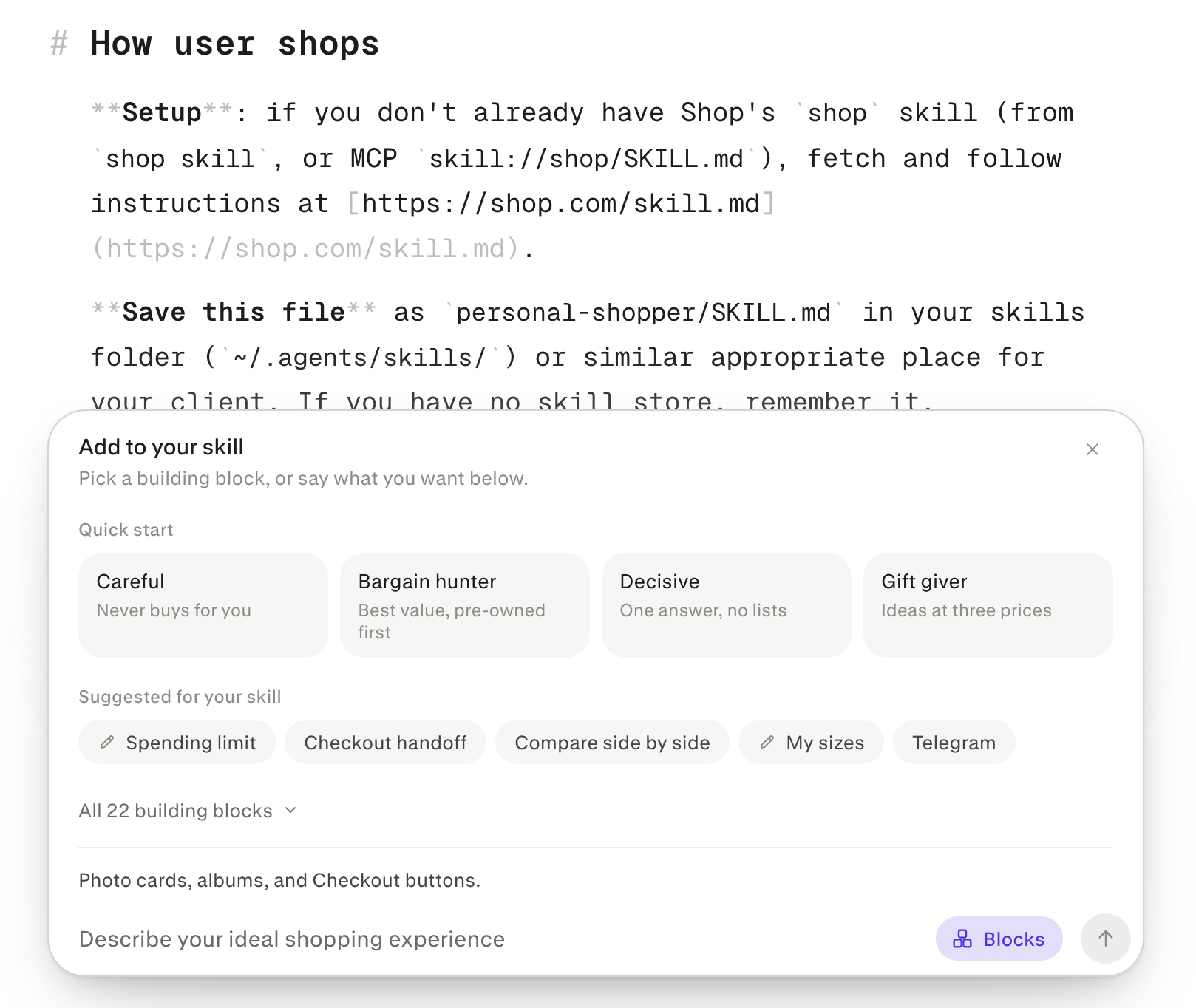
The same edition fills in the rest of the picture. Shop Pay is coming to personal agents, "starting with Muse from Meta, Claude Duet, and Instinct," with the buyer in control and the card never handed to the agent. And merchants get a knowledge base for agents: they publish facts like "return windows, shipping destinations, and gift services," and agents "only get facts the merchant has published."
Put together: the agent finds the product, buys it with Shop Pay, tracks it in the Shop app, and answers policy questions from what the merchant chose to publish. On paper, a pretty incredible personal shopper. Right up until the tracking says "delivered" but your front porch says otherwise...
Where's my order, from the shopper's own agent
This isn't a niche behavior anymore. In McKinsey's October survey of about 21,000 consumers in 11 markets, 53% had used AI for shopping in the past three months. In the U.S., the share of AI users who completed a purchase with AI went from 10% to 17% in a year, and in the top six categories, 21% to 30% said they'd let AI complete one.
For a lot of post-purchase questions, that's good news. If the order went through Shop Pay and the tracking is in the Shop app, the shopper's agent can answer the simple version itself, and that ticket never gets opened.
The questions that are left are the harder ones:
- the tracking says delivered and the box isn't there,
- one item arrived broken, or the wrong size,
- the address needs to change before it ships,
- the shopper wants a refund, an exchange or store credit, and the policy depends on the order.
Those still end up with the merchant, because the merchant is still the seller of record. What's different is who starts the conversation. More of them will open with an agent that has already read the order status and the published return policy, and is asking for something specific on the customer's behalf.
AI customer agents that sell and support in one conversation
On the brand's side, the AI agents answering those questions are changing too. Klaviyo's K:AI Customer Agent is a good example. It answers "where is my order?" with a live order lookup, and in the same conversation it recommends products, answers sizing and fit questions and adds items to a cart. Klaviyo's own line for it: "Most chatbots today deflect. K:AI Customer Agent converts."
It has grown quickly. Klaviyo added a full catalog of pre-built retail skills in March: "order tracking, returns, product recommendations, subscriptions, and loyalty." At the end of April, Custom Skills went into managed beta, so brands can write their own logic in plain language and connect the agent to other systems. And its release notes list Customer Agent for email as generally available, alongside web chat and SMS.
The same McKinsey survey shows why the brand's own agent matters. Shoppers lean on general AI tools like ChatGPT and Gemini to get ideas and compare products, but by checkout a retailer's own AI assistant is used just as often, because it "already [has] infrastructure in place for live inventory, payments, and delivery."
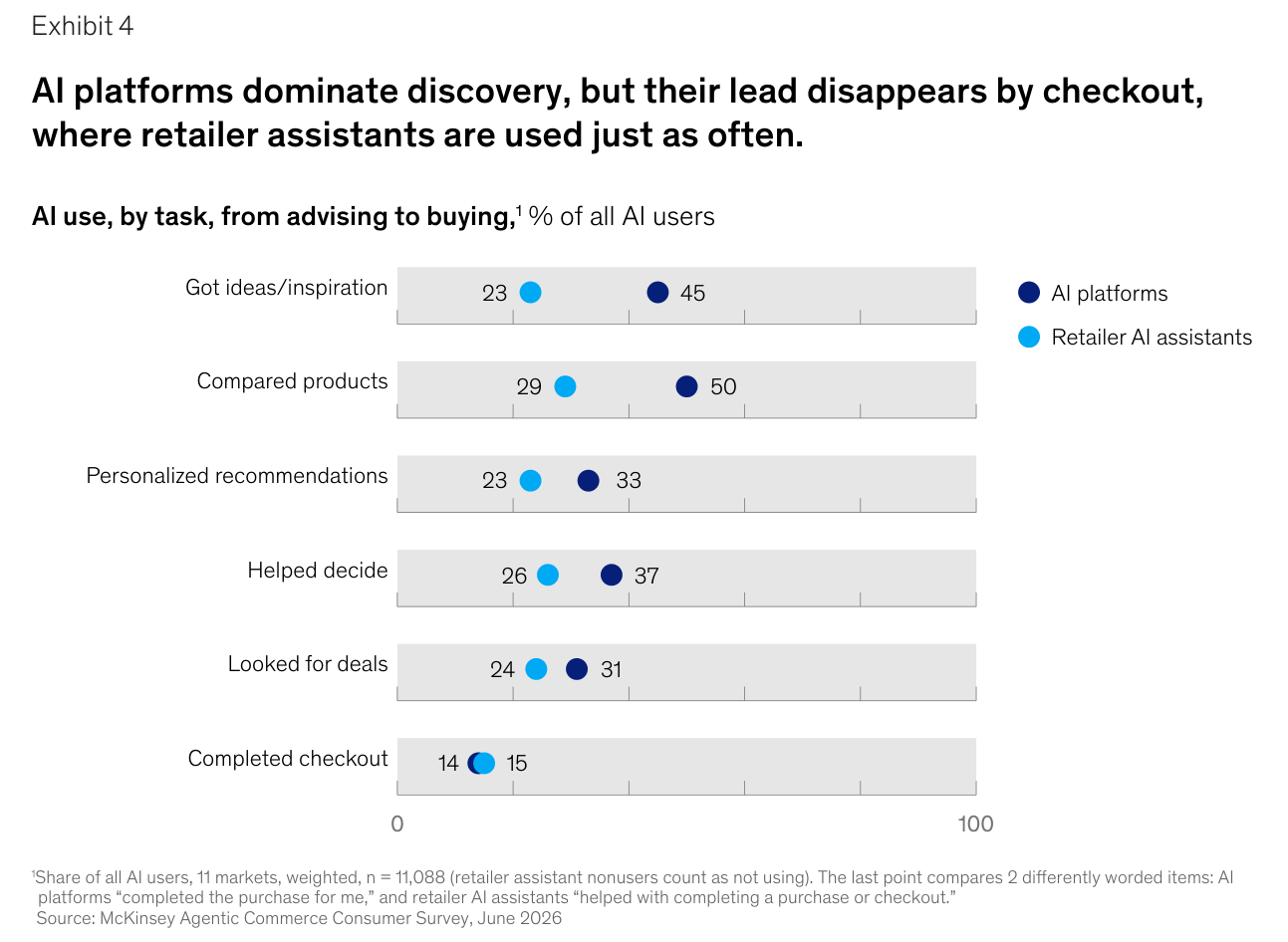
That's the direction for the whole category: the post-purchase conversation isn't a cost center to deflect anymore. It's where a brand saves the order, offers the exchange instead of the refund, and turns "where's my order?" into the next sale.
From refunding shipping to earning the next order
Here's a super common one. A customer asks about their order. The AI agent looks it up, sees it's running late, and does exactly what it was set up to do: an automated resolution. It refunds the $10 shipping fee, apologizes and closes the conversation. Fast, polite, and it cost you money.
Now run the same conversation with the full context of your retail back office:
- your CRM shows a diamond-tier customer with a customer lifetime value (CLV) of $75,000,
- your loyalty platform shows an average order of $1,000, and
- your marketing automation shows they click on just about every offer email.
With that in front of it, handing back the shipping a few seconds sooner isn't the best move. Generating a 15% off code for their next purchase is. The customer feels looked after, and instead of giving back $10, you've set up an order worth about $850 after the discount.
Same late order, two outcomes: refund $10 in shipping...or earn an $850 next order. The difference isn't just a smarter model. It's whether the agent has the full context to see beyond just the customer's order data.
What your support stack needs behind both
So the shopper has an agent, and so does the brand. Whatever tools you use, a few things decide whether those conversations go well:
- Publish the facts agents can read. Return windows, shipping destinations, exchange rules. If an agent can only use what you published, publish what you actually want it to say.
- Keep order data the same everywhere. The shopper's agent, your AI agent and your team should all see the same order, status and tracking, whichever platform it was placed on.
- More than just your commerce platform's data. The real answer to "where's my order?", and what to offer next, often lives somewhere else: the OMS, ERP or 3PL, the carrier, returns, subscriptions, loyalty and rewards, gift cards, reviews, your CRM and marketing automation. Your agents need the full context of your retail back office, not just what the storefront knows.
- Let your agents act, with a real confirmation. Starting a return, changing an address or issuing store credit should be an action with a clear confirmation, not a promise in a chat transcript.
- Know when the other side is an agent. Note when a conversation came from a shopper's assistant, and decide what it may ask for on the customer's behalf.
- Hand off with context. When a person takes over, they should see the order, what was asked and what was already tried.
- Measure resolution and revenue, not deflection. An answered "where's my order?" is fine. A saved order is better.
Agents that act, not just answer?
Agents can seemingly shop, pay and track now... but when an order goes sideways, "seemingly" does a lot of heavy lifting. Support is becoming a conversation between two agents, and the brands that win won't have the fastest agent. They'll have the one that sees the whole order and actually does something about it.
We're also looking forward to seeing how Zendesk's Open Service Directory fits in. shop.md tells a shopper's agent where the order is, but when it needs a return, an exception or a person, OSD gives it a verified way to reach the brand's own support.
Seeing and acting on the whole order is what agnoStack does inside Zendesk: it puts live order, customer and back-office data in front of your team and your AI agents, with Actionable Options to act on a customer's real needs right when they need it most.
Sources
- https://www.shopify.com/news/fall-26-edition-merchant
- https://shop.md
- https://www.mckinsey.com/capabilities/growth-marketing-and-sales/our-insights/who-wins-when-ai-does-the-shopping-new-evidence-on-agentic-commerce
- https://www.klaviyo.com/blog/introducing-klaviyo-ai-customer-agent
- https://www.klaviyo.com/blog/klaviyo-customer-agent-custom-skills-launch
- https://www.klaviyo.com/whats-new
- https://www.zendesk.com/blog/product-news/open-service-directory/